Office lease renovation rules Singapore, What Your Office Landlord Will And Will Not
What are the rules for renovating a leased office in Singapore?
Renovating a leased office in Singapore usually needs landlord approval, and often BCA or JTC compliance plus reinstatement at lease end. Check your tenancy agreement early for what you can change and what must be restored at handover.
You signed a 3-year office lease at a Grade B building in Tanjong Pagar. You budgeted S$45,000 for a full renovation. Then you read the lease. No hacking. No wet works. No changes to the ceiling grid. Suddenly, half your design is off the table.
This is one of the most common and expensive surprises tenants face in Singapore. The lease you signed does not just control your rent. It controls what you can build inside your own office.
What Can You Actually Renovate in a Leased Singapore Office?
[Answer Capsule]In most Singapore commercial leases, tenants can freely carry out cosmetic upgrades like repainting, carpeting, installing furniture, and adding partition walls. Structural changes, MEP (mechanical, electrical, plumbing) modifications, ceiling works, and anything that triggers SCDF fire safety re-certification typically require written landlord approval. Budget S$80 to S$150 PSF for cosmetic fit-outs and S$150 to S$250+ PSF if MEP or layout changes are involved.
Structural Changes vs Cosmetic Updates: Where the Line Falls
The distinction between “allowed” and “needs approval” almost always comes down to one question: does the work affect the building’s base structure, shared systems, or fire safety compliance?
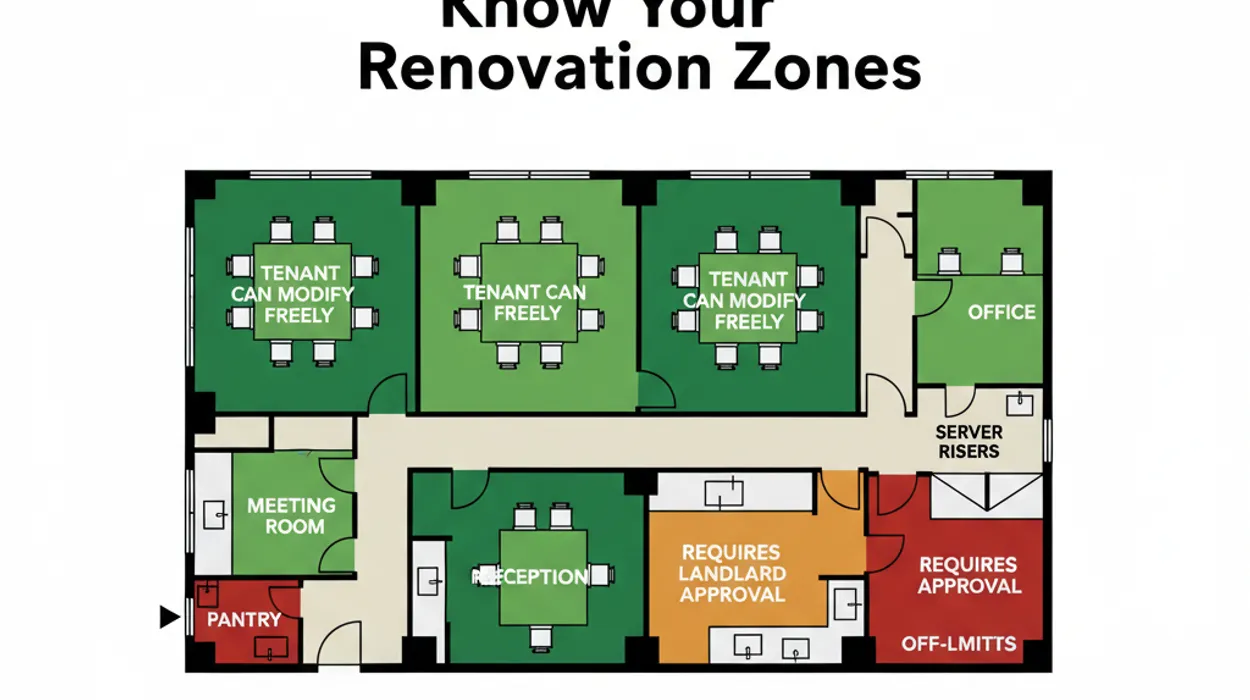
What Tenants Can Usually Do Without Approval
These items are generally classified as cosmetic or tenant fit-out works:
Repainting walls within the demised premises
Carpet or vinyl flooring installation over existing raised floors
Furniture, workstations, and shelving (freestanding, not anchored to structure)
Low-voltage cabling for data, phones, and AV systems
Partition walls using lightweight drywall or glass (not load-bearing)
Window blinds or film (subject to building facade guidelines)
What Almost Always Requires Landlord Written Consent
Hacking of floor tiles or screed to re-route plumbing or level surfaces
Ceiling grid removal or modification, especially if it exposes fire sprinkler systems
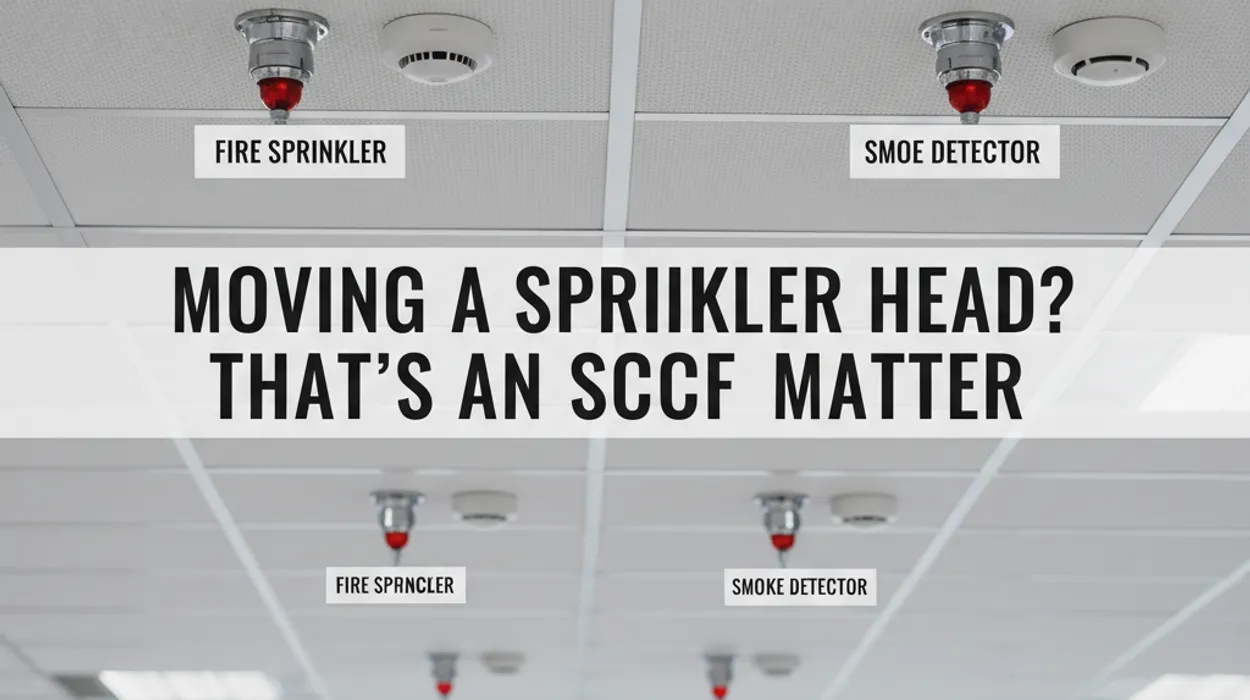
Relocation of sprinkler heads, smoke detectors, or fire alarm devices
MEP works including rerouting of air-conditioning ducting, adding electrical sub-boards, or relocating water points
Structural penetrations such as core drilling through walls, floors, or columns
Wet works including pantry sinks, showers, or any new water supply/waste points
External signage on the building facade, lobby directory, or common corridors
Heavy equipment that exceeds the floor loading capacity (typically 2.5 kN/sqm to 5.0 kN/sqm for standard offices)
In our experience handling commercial office renovations across the CBD and business parks, sprinkler relocation alone can add S$3,000 to S$8,000 to a project. Many tenants do not account for this until the SCDF plan submission stage.
Common Lease Clauses That Limit Your Renovation
If you have not read your lease carefully, here are the clauses that catch most tenants off guard.
1. Reinstatement Clause
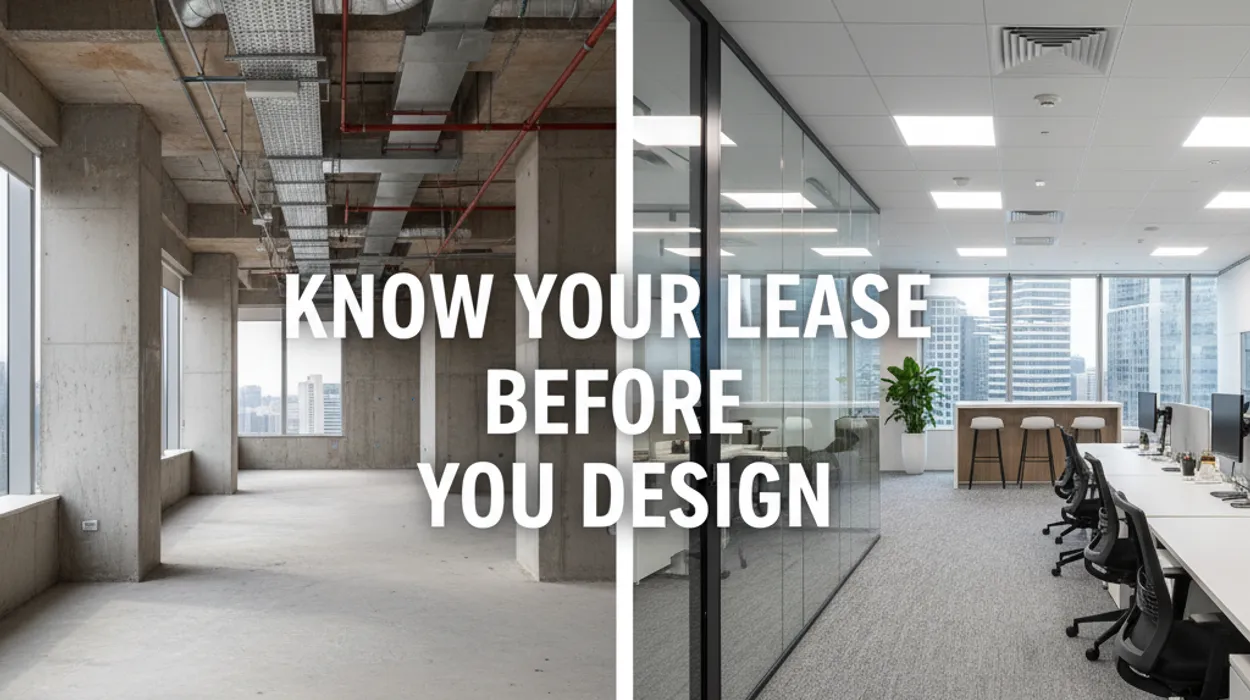
This is the most expensive clause most tenants ignore. It requires you to return the unit to its original condition when the lease ends. That means ripping out everything you built, including partition walls, flooring, and ceiling works.
Reinstatement costs in Singapore typically range from S$10 to S$25 PSF for standard scope (partition removal, repainting, floor restoration). CBD Grade A offices with extensive MEP reinstatement can push this to S$35 PSF or more. For a 2,000 sqft office, that is S$20,000 to S$70,000 at lease end. Some landlords allow partial reinstatement or “as-is” handover if the next tenant wants the existing fit-out. But you need this in writing.
2. Approved Contractor Clause
Many landlords, especially in Grade A buildings managed by CapitaLand, Keppel Land, or Mapletree, require tenants to use pre-approved contractors or at minimum submit contractor credentials for vetting. This limits your ability to pick the cheapest quote and can affect your renovation timeline.
3. Renovation Deposit
The MCST or building management typically collects a renovation deposit of S$3,000 to S$10,000 before any work starts. This deposit covers potential damage to common areas (lifts, lobbies, corridors) during the renovation. It is refundable after inspection, but delays of 30 to 90 days on refund processing are standard.
4. Permitted Work Hours
Most commercial buildings in Singapore restrict noisy renovation works (hacking, drilling, heavy machinery) to weekends and public holidays only, or after 6:00 PM on weekdays. Some buildings allow noisy works between 9:00 AM and 5:00 PM on Saturdays only. This directly affects your renovation timeline. A project that takes 3 weeks in a building with flexible hours might take 5 to 6 weeks in one with strict restrictions.
5. No Alteration to Facade or Common Areas
Your lease almost certainly prohibits any changes to the building’s external appearance. This includes window tinting that does not match the building standard, external signage without approval, and modifications to the main entrance if your unit faces a common corridor.
The Pre-Approval Process With Your Landlord
Renovating a leased office in Singapore is not just between you and your contractor. Here is the typical approval chain.
Step 1: Submit Renovation Proposal to Building Management
Before any work begins, submit a renovation proposal to the building’s MCST or property management office. This includes floor plans, scope of works, contractor details, insurance certificates, and a proposed schedule.
Step 2: MCST Review and Deposit Collection
The MCST reviews your plans against building rules. They check for potential impact on shared systems (fire, HVAC, electrical risers), noise, access to common areas during works, and compliance with building renovation guidelines. Once approved, you pay the renovation deposit.
Step 3: Landlord Consent (If Required by Lease)
If your scope includes any of the “requires approval” items listed above, you need separate written consent from the landlord. This is different from MCST approval. The landlord may impose conditions, such as using a specific M&E subcontractor or requiring professional engineer (PE) endorsement for structural works.
Step 4: Statutory Submissions
Depending on the scope:
SCDF/FSSD: If you are relocating sprinkler heads (especially more than 9 heads), modifying fire-rated partitions, or changing the tenancy layout in a way that affects means of escape, you must engage a Qualified Person to submit plans to the Singapore Civil Defence Force. SCDF plan submission fees are S$160 per 100 sqm of floor area. This process can take 2 to 4 weeks. A Registered Inspector (RI) must inspect the completed works before SCDF issues the Fire Safety Certificate (FSC), which is required before you can legally occupy the space.
BCA: If structural works are involved (removing walls, core drilling, adding mezzanine levels) or the renovation contract value exceeds S$30,000, a BCA written permission under Addition & Alteration (A&A) regulations is required. This requires a Qualified Person (architect or PE) to submit plans via the CORENET e-Submission system.
Step 5: Renovation Commencement
Once all approvals are in hand, work can begin. The contractor must follow MCST rules on work hours, debris disposal, lift usage for material transport, and protection of common areas.
Approval Stage
Typical Timeline
Cost to Tenant
MCST review
1 to 2 weeks
S$3,000 to S$10,000 deposit
Landlord written consent
1 to 3 weeks
Nil (but may require PE fees)
SCDF plan submission
2 to 4 weeks
S$500 to S$2,000 (consultant fees)
BCA A&A permit
4 to 8 weeks
S$3,000 to S$10,000 (QP fees)
Total pre-work lead time
4 to 12 weeks
S$6,500 to S$22,000+
How to Negotiate Renovation Scope With Your Landlord
The best time to negotiate renovation scope is before you sign the lease. The second best time is during any lease renewal. Here are proven approaches.
Ask for a Renovation Allowance or Rent-Free Fit-Out Period
Many landlords offer 1 to 3 months of rent-free fit-out period for new leases. For larger tenancies (5,000 sqft and above), a renovation allowance of S$10 to S$30 PSF is sometimes available, especially in buildings with high vacancy. This is negotiable and should be part of your Letter of Offer discussions.
Request a Partial or Full Reinstatement Waiver
If you are investing significantly in upgrading the unit, propose a partial reinstatement waiver. Frame it as a benefit to the landlord: “We are spending S$120,000 to upgrade the unit with modern finishes and a new pantry. The next tenant will benefit from this. We request a waiver on reinstating partition walls and flooring.” Get any agreed waiver in the Tenancy Agreement, not as a side letter.
Pre-Agree on Permitted Works List
Before lease signing, submit your renovation concept plans and request a written “Permitted Works” schedule as an annex to the lease. This removes ambiguity and prevents disputes later. Specify items like: pantry wet works, ceiling modification zones, and sprinkler relocation allowances.
Propose a Landlord Inspection at Lease End Instead of Full Reinstatement
Instead of a blanket reinstatement clause, negotiate for a joint inspection clause. The landlord inspects the unit at lease end and issues a reinstatement scope based on actual condition, not a default “strip everything” requirement.
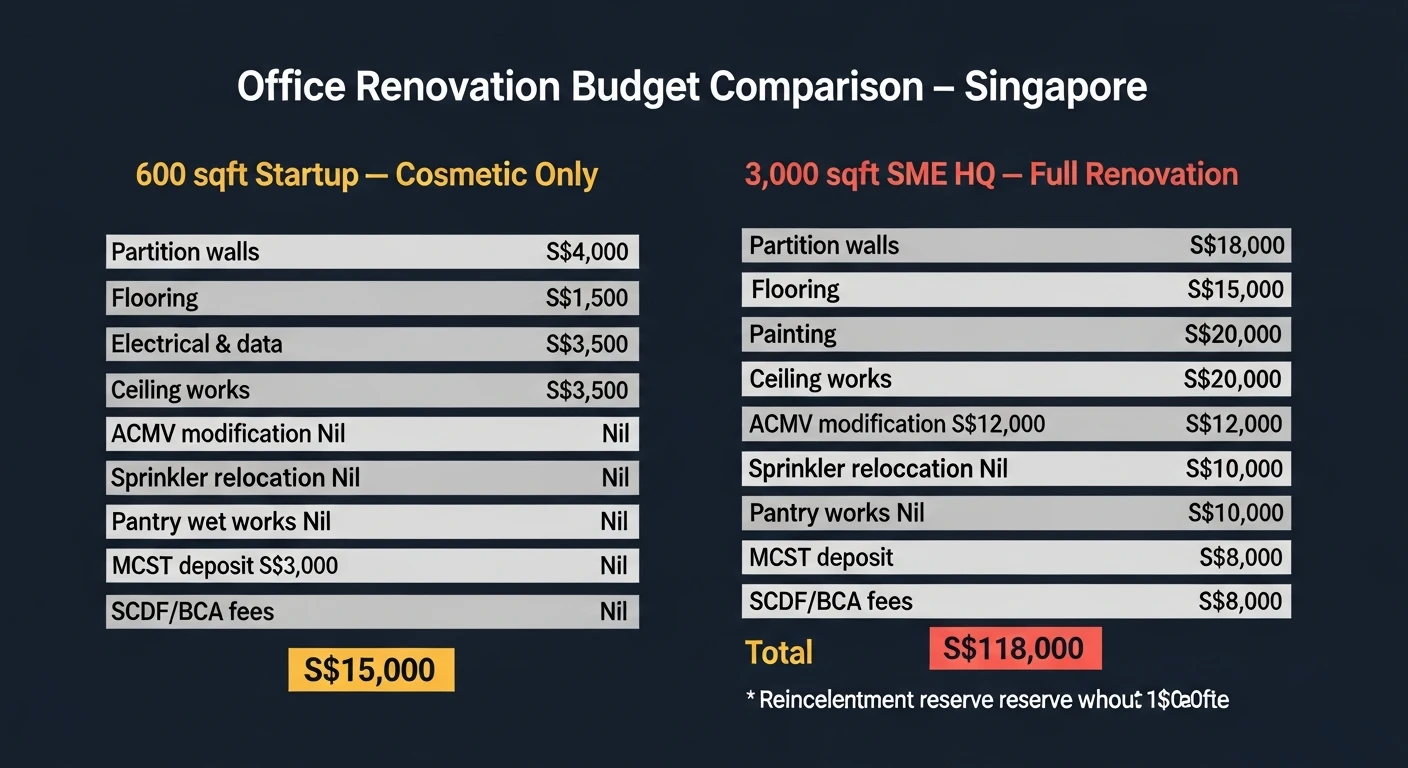
Budget Comparison: Cosmetic Fit-Out vs Full Renovation in a Leased Office
Item
600 sqft Startup (Cosmetic Only)
3,000 sqft SME HQ (MEP + Layout Changes)
Partition walls
S$4,000
S$18,000
Flooring (vinyl/carpet)
S$3,000
S$15,000
Painting
S$1,500
S$6,000
Electrical and data cabling
S$3,500
S$20,000
Ceiling works
Nil (existing grid)
S$12,000
ACMV modification
Nil
S$15,000
Sprinkler relocation
Nil
S$6,000
Pantry (wet works)
Nil
S$10,000
MCST deposit
S$3,000
S$8,000
SCDF/BCA fees
Nil
S$8,000
Estimated Total
S$15,000 (S$25 PSF)
S$118,000 (S$39 PSF)
Reinstatement Reserve
S$6,000 (S$10 PSF)
S$60,000 (S$20 PSF)
The reinstatement reserve is not a renovation cost. It is a cost of leaving. Most tenants forget to factor it in until the final quarter of their lease.
Before You Renovate, Read Your Lease
Every renovation decision in a leased Singapore office starts with one document: your Tenancy Agreement. Not your mood board. Not your Pinterest saves. Your lease.
If you are planning an office renovation and want clarity on what your landlord will approve, contact MetaDesign Interior for a consultation. We handle the full process from lease review to MCST submissions, SCDF compliance, and final fit-out delivery.
For official guidelines on fire safety requirements, refer to the SCDF Fire Safety Guidelines for Building Works. For structural works and BCA permit requirements, visit BCA’s Building Control Regulations.
"We entrusted MetaDesign Interior with our office renovation, and they exceeded all expectations. The smart space planning and modern design have not only improved productivity but also created a vibrant working environment."
Office Renovation— Marcus Tan,Tech Solutions Pte Ltd
"MetaDesign Interior helped us maximize our office space in the CBD. Their space planning strategies allowed us to add more workstations while keeping the environment open and comfortable. Truly impressive!"
Space Planning— Hui Ling, Creative Director, Imagine Studios
"The custom furniture by MetaDesign Interior has brought our workspace to life. Every piece was carefully crafted and tailored to our exact needs, blending seamlessly with our office design."
Custom Furniture Design— Aaron Lim, Partner, Lim & Wong LLP